Catholic Social Teaching

Catholic social teaching applies the Gospel to society, built on the dignity of every person and the common good.

Live 15 minutes CCC 1877–1948, 2419–2449

Read the story

Reading voice

Speed

Hello! I will read the story to you.

Voices come from your device. If one sounds odd, choose another.

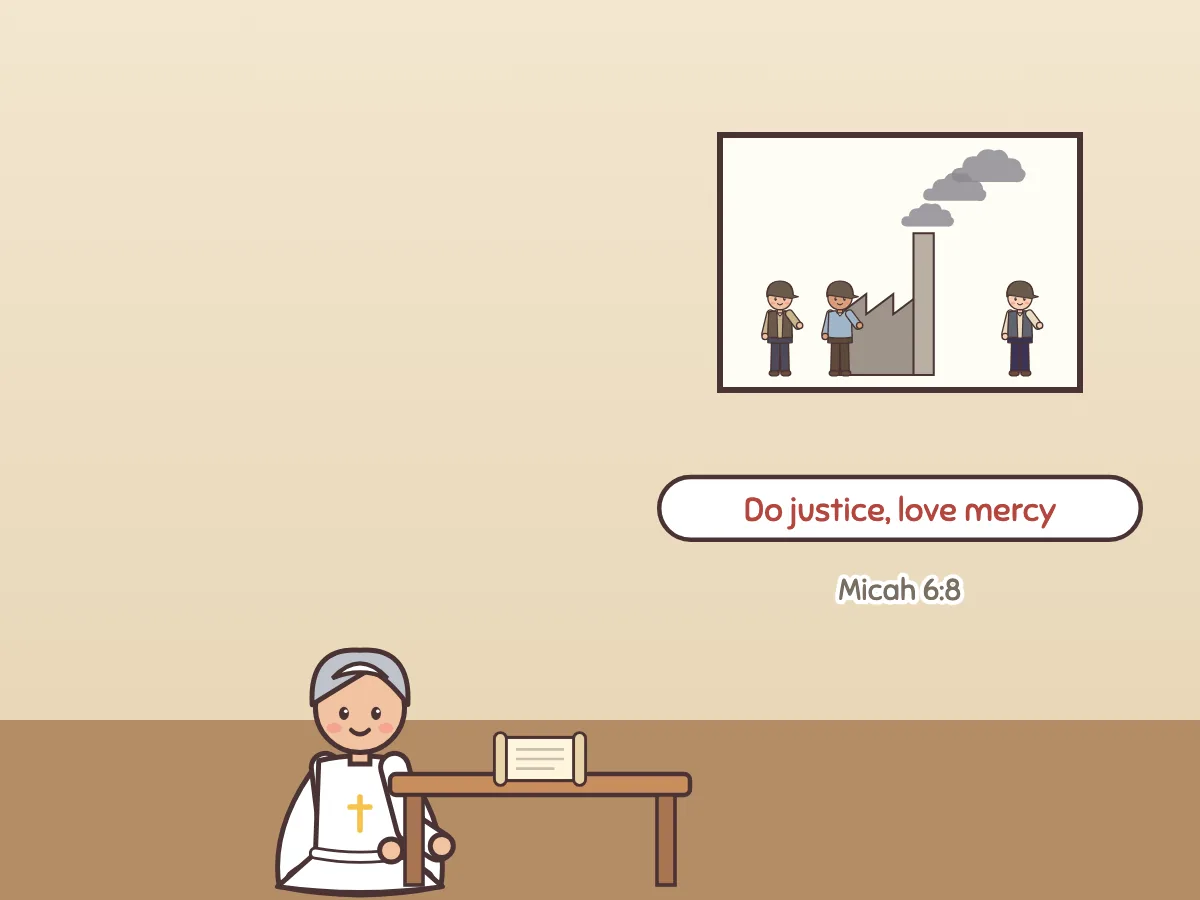
Pope Leo XIII writing at his desk with a picture of factory workers on the wall, and a prophet's scroll beside him reading “Do justice, love mercy.”

Faith is personal, but it is never only private. The prophets spoke out against injustice, and Jesus identified Himself with the hungry, the stranger and the prisoner. Since Pope Leo XIII's Rerum Novarum in 1891, the Church has developed a body of teaching on how to build a just society, called Catholic social teaching.
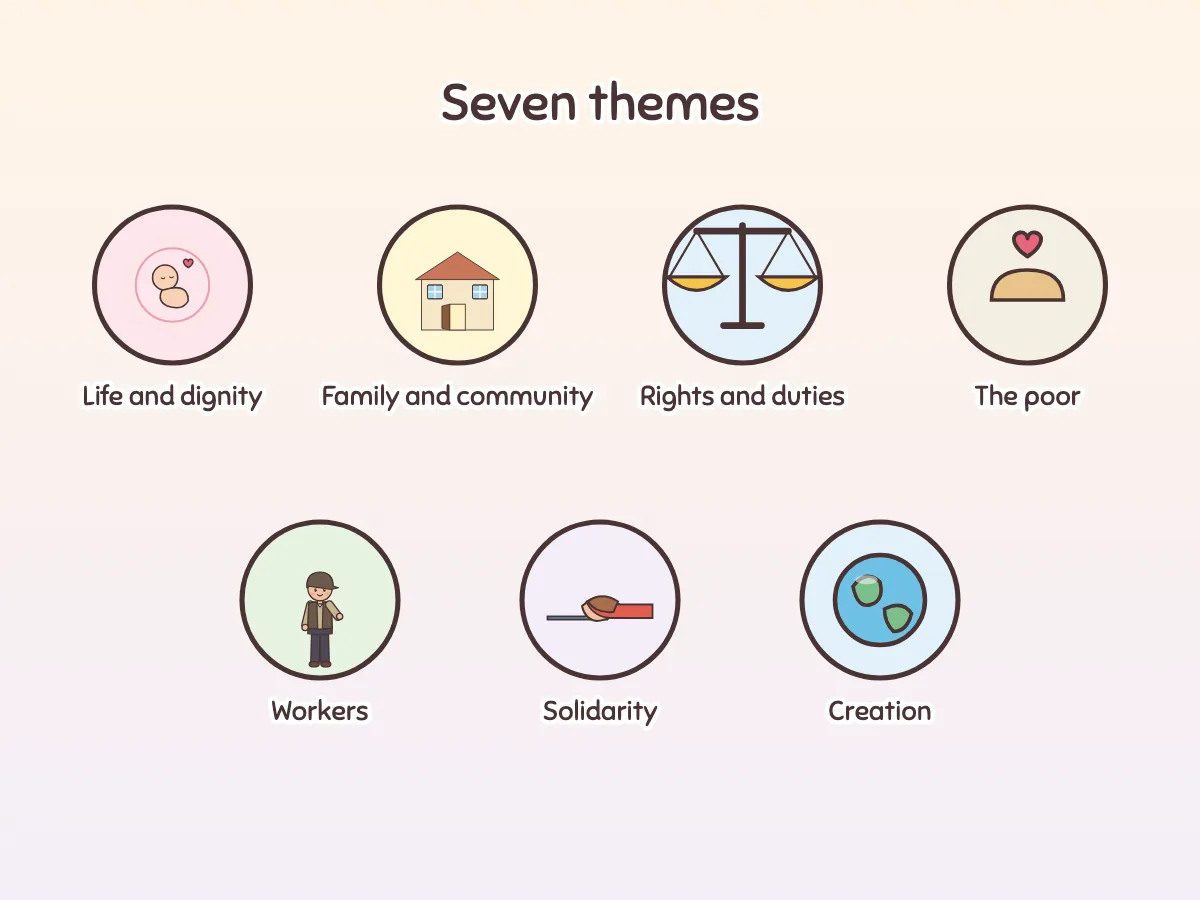
Seven themes of Catholic social teaching in seven circles: life and dignity, family and community, rights and responsibilities, the poor, workers, solidarity and creation.

The bishops of the United States sum it up in seven themes:

  1. Life and dignity of the human person.
  2. Call to family, community and participation.
  3. Rights and responsibilities.
  4. Option for the poor and vulnerable.
  5. The dignity of work and the rights of workers.
  6. Solidarity.
  7. Care for God's creation.
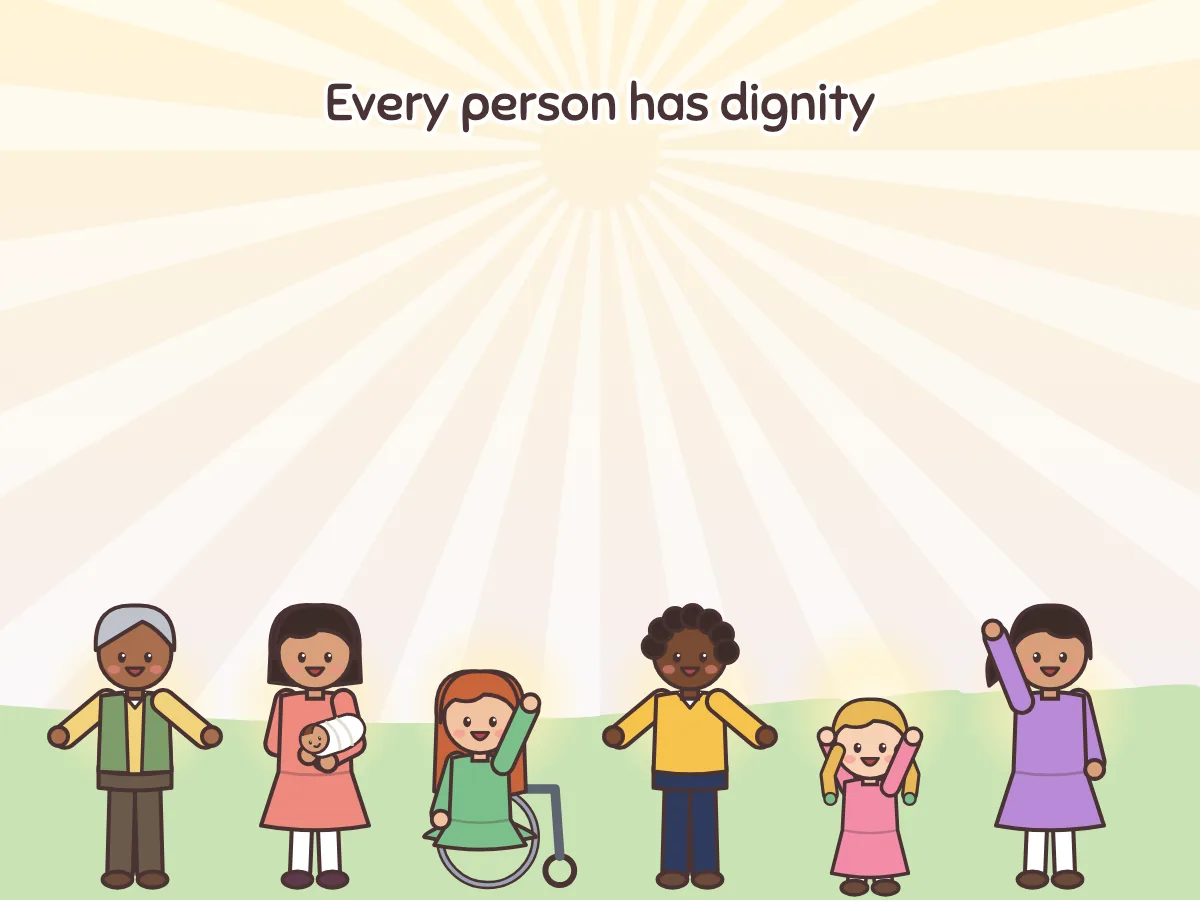
People of every race, age and ability standing together, including a person in a wheelchair and a baby in a mother's arms, each with a golden glow: every person has dignity.

Everything starts with human dignity. Every person, from conception to natural death, whatever their race, religion, ability, wealth or citizenship, is made in God's image and has a worth no one can take away. Society exists for the person, not the person for society or the economy.
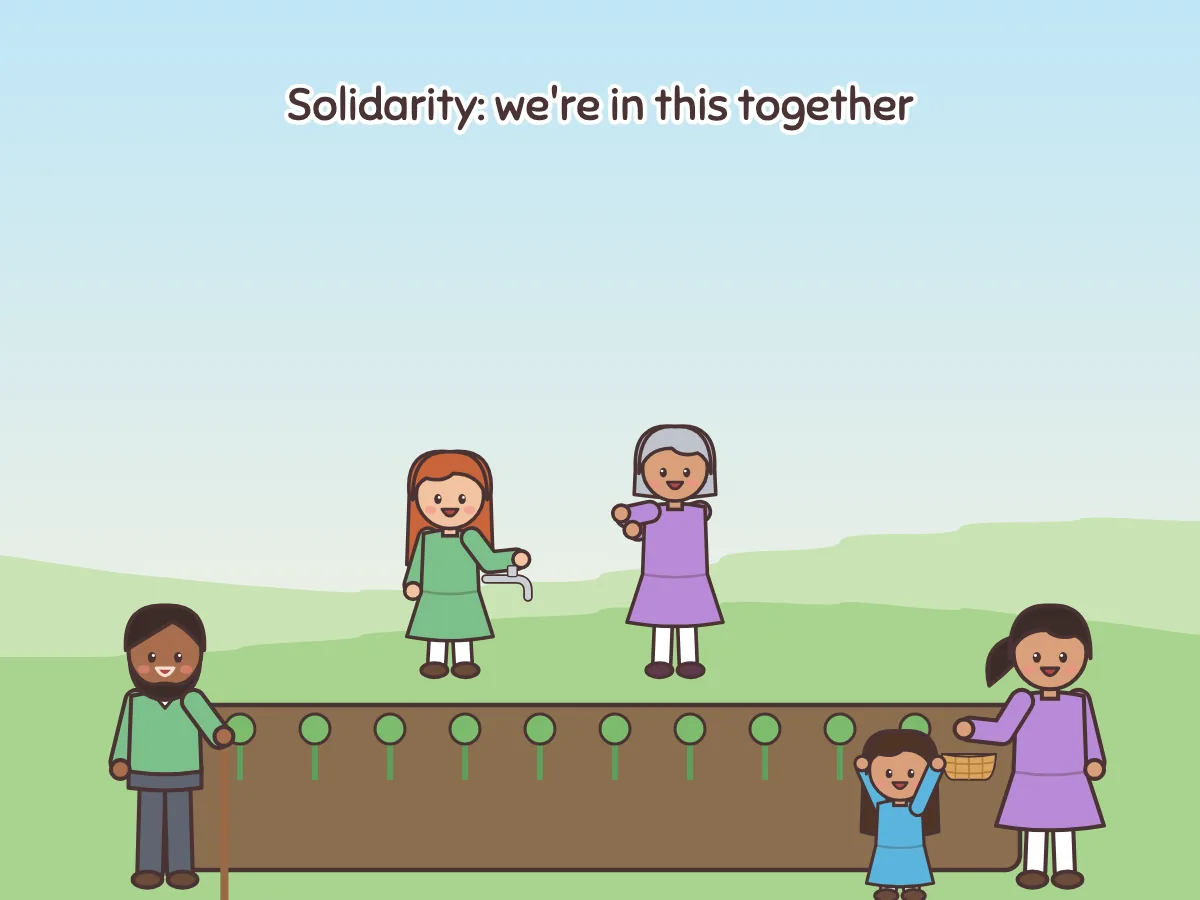
Neighbours from different countries working together to build a community garden, sharing tools and food: solidarity and the common good.

The common good is the set of conditions that let all people, as groups and as individuals, flourish: peace, safety, education, health care, fair laws and a healthy environment. Two principles help. Solidarity means we are responsible for one another, even across borders. Subsidiarity means decisions should be made at the most local level that can handle them well, with larger bodies helping families and communities, not replacing them.
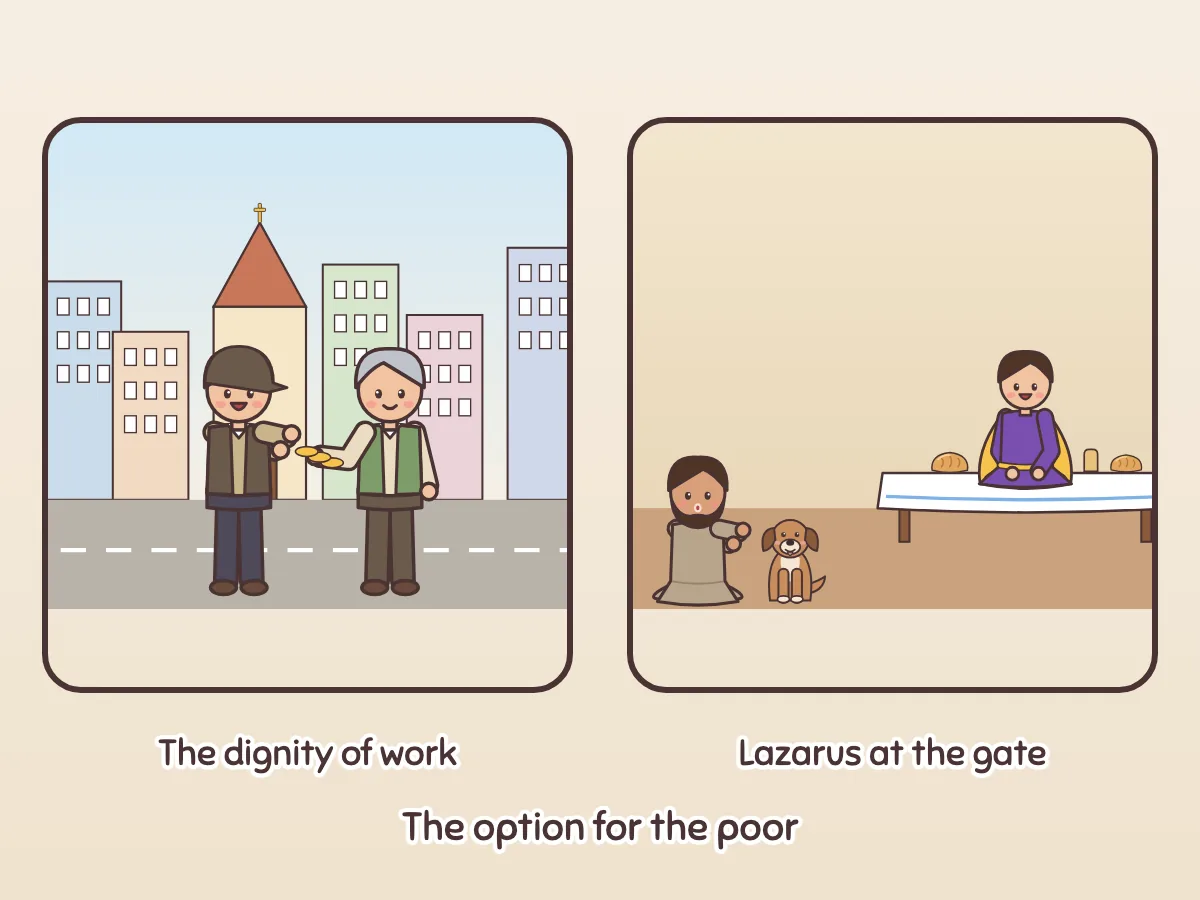
A worker receiving fair pay and a family resting on Sunday, beside Jesus' parable of the rich man and poor Lazarus at the gate.

The option for the poor means a society is judged by how it treats its most vulnerable members, as in Jesus' parable of the rich man and Lazarus. Work has dignity because it shares in God's creative work: workers deserve fair wages, safe conditions and rest, and the economy must serve people, not the other way around.
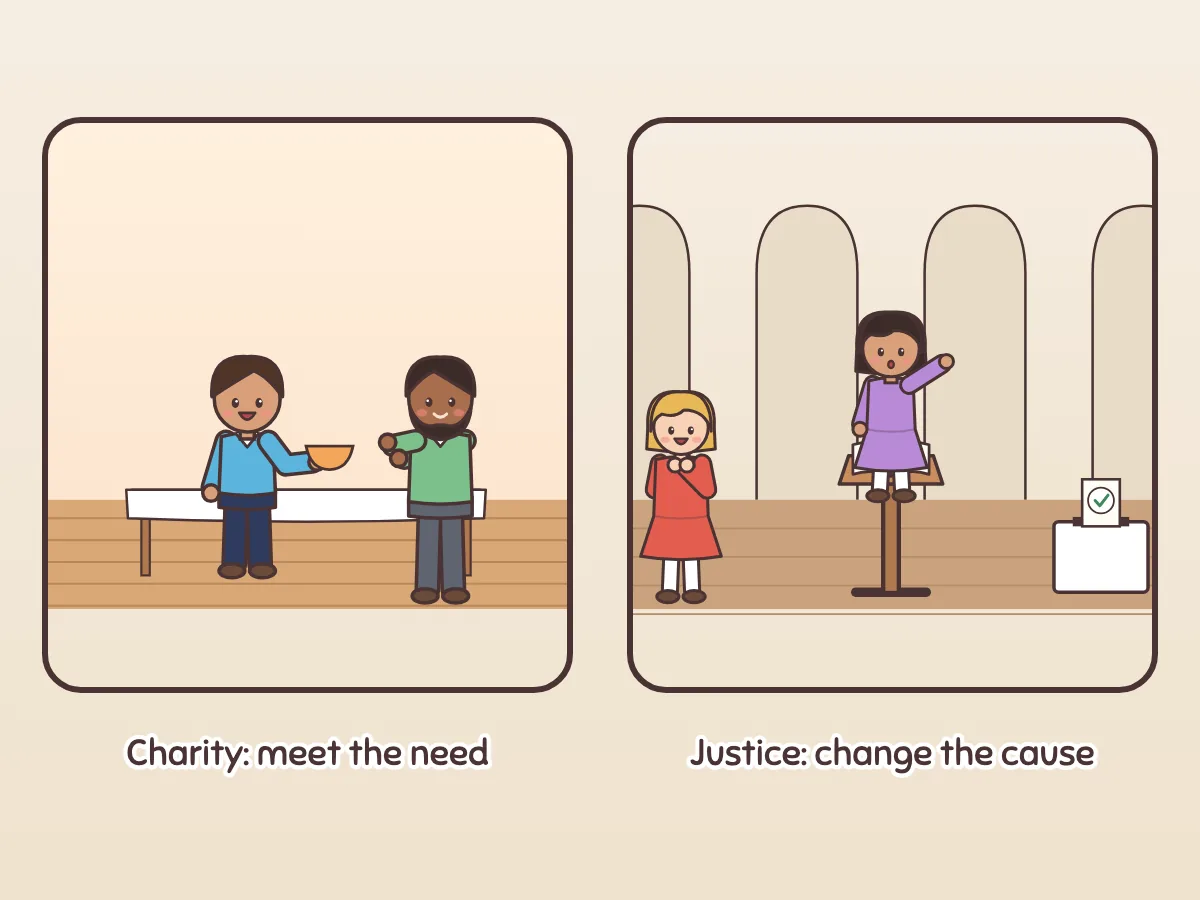
Two pictures side by side: volunteers handing out food at a soup kitchen (charity), and young people speaking at a town meeting and voting (justice).

Catholic social teaching does not fit neatly into any political party. It asks Catholics to form their consciences and bring the whole Gospel into public life: protecting life, welcoming the stranger, caring for the poor and creation, and supporting families. Charity meets immediate needs; justice changes the causes. Christians need both.

Catechism: CCC 1877–1948, 2419–2449Scripture: Micah 6:8 · Matthew 25:31–46 · Acts 4:32–35

Words to know

Tap a card to flip it
Keep this in your heart
Every person has God-given dignity, and I share responsibility for a society where all can flourish.

Say it out loud three times. Tap a circle each time!

Quiz

  1. Which document began modern Catholic social teaching?
    Answer: Rerum Novarum (1891)
  2. What is the foundation of all Catholic social teaching?
    Answer: The dignity of the human person
  3. What is solidarity?
    Answer: A firm commitment to the good of all
  4. What does subsidiarity mean?
    Answer: Decisions are made at the most local level able to handle them well
  5. What is the difference between charity and justice?
    Answer: Charity meets immediate needs; justice changes the causes

Pray & do

Christ has no body now on earth but yours, no hands but yours, no feet but yours. Yours are the eyes through which He looks with compassion on the world. Lord, make me Your hands and feet for the poor. Amen.

Activity

Pick one of the seven themes and one issue in your area connected to it. Research the facts, read what the Church teaches, and plan one act of charity and one act of justice in response.

Family corner

Choose a family service project this month, such as serving a meal, visiting a nursing home or collecting supplies for refugees. Afterward, talk about what you learned about human dignity.

Lesson complete!

Today's big idea: Catholic social teaching applies the Gospel to society, built on the dignity of every person and the common good.